Lion's Mane extract: how it's made and what to look for
Published · Updated · 3 min read
In this article
What is Lion's Mane extract?
It’s what’s left when you take the useful parts out of dried Lion’s Mane and leave the rest behind. Lion’s Mane, like all mushrooms, has tough cell walls made of chitin, which your body doesn’t digest well. Extraction breaks those walls down and pulls the compounds out into a liquid. That liquid is either sold as a tincture (drops) or dried into a powder for capsules.
Fruiting body or mycelium?
This is the first thing to check on any label:
- Fruiting body: the part of the mushroom you can see, the white shaggy ball. It’s what people eat, and what the human Lion’s Mane studies used.
- Mycelium: the root-like threads the mushroom grows from. It’s cheaper to grow, often on grain, and when it’s sold with the grain still in it, part of what you’re buying is grain.
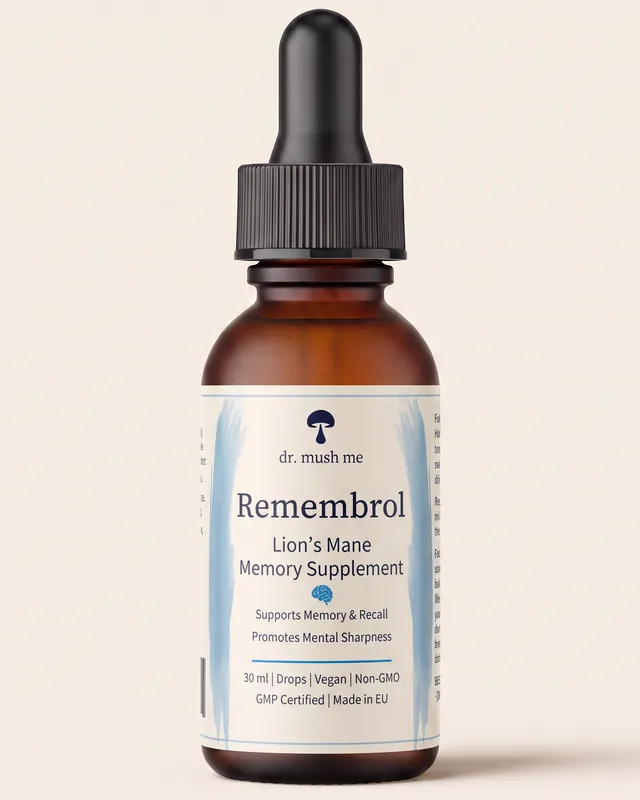
Our Remembrol drops are made from the fruiting body.
How Lion's Mane extract is made
Hot water extraction
Dried mushroom is simmered in water. This is the traditional method and the one that pulls out beta-glucans, the polysaccharides most often measured in mushroom extracts.
Alcohol extraction
Dried mushroom is soaked in food-grade alcohol. This pulls out compounds that don’t dissolve in water. For Lion’s Mane, that includes the hericenones that are often talked about.
Dual extraction
Both: water and alcohol, either one after the other or as a mix. Most tinctures, ours included, are dual extracts, because each solvent picks up things the other misses.
Ultrasonic-assisted extraction
Sound waves are used during extraction to break up the cell walls faster. It means less time at high heat. Our drops are made this way, in Poland, from dried fruiting body powder, water and food-grade alcohol (under 22%).
Drops, capsules or powder?
| Form | What it is | Good for |
|---|---|---|
| Tincture (drops) | liquid dual extract in water and alcohol | easy to measure, goes into drinks; contains a little alcohol |
| Extract capsules | dried extract powder in a capsule | no taste, no alcohol; check the ratio and part used |
| Whole powder | dried, ground mushroom, not extracted | cooking and smoothies; you’re eating the whole mushroom, cell walls included |
How to tell if an extract is any good
In 2026, Mycogenius, working with Shannon ABC at the Technological University of the Shannon, published lab results for 30 Lion’s Mane extracts. Beta-glucan content ranged from under 5% to 82%, and the hericenones C and D that many labels mention weren’t found in any meaningful amount in any of the 30. The lesson: the label doesn’t tell you what’s in the bottle. A lab report does.
What to look for:
- Part of the mushroom: fruiting body or mycelium, stated clearly.
- Extraction method: water, alcohol or dual.
- Amount per daily dose, not a big number for the whole bottle.
- A lab report you can read: heavy metals (lead, cadmium, mercury) and microbes at minimum. Ours, from J.S. Hamilton Poland, is on the Remembrol page.
How to take Lion's Mane extract
Follow the label. For our drops: 1 ml (about 30 drops) once a day, no more than 2 ml. Hold under the tongue for about 90 seconds or stir into tea or coffee. The drops dosage guide has a calculator, and our Lion’s Mane dosage guide covers powders and capsules.
A few ideas for drinks: morning coffee, green tea, a smoothie, or a cacao. Heat drives off some of the alcohol, if you’d rather less of it.
Side effects and who should avoid it
- The most common side effect is an upset stomach. Taking it with food usually helps.
- Avoid it if you’re allergic to mushrooms, pregnant or breastfeeding, or for children.
- If you take any medicine, especially for blood sugar or blood clotting, check with your GP or pharmacist first.
Questions people ask
Is Lion's Mane extract better than powder?
They’re different. Extract is concentrated and easier to take; powder is the whole mushroom. If you want the compounds out of the cell walls, extract does that job.
What does 10:1 mean on a label?
That 10 kg of dried mushroom went into making 1 kg of extract.
Does Lion's Mane extract contain alcohol?
Tinctures do. Our drops are under 22% alcohol, which works out to about 0.17 g of alcohol in a 1 ml dose. Capsules and powders don’t contain alcohol.
Sources
- NutraIngredients. Mycogenius talks tackling the mushroom supplement transparency challenge (May 2026). nutraingredients.com
- Remembrol Lion’s Mane drops label, supplier specification and J.S. Hamilton Poland lab report.
This article is general information, not medical advice. If you take any medication, talk to your GP or pharmacist before taking any supplement.
This article is general information, not medical advice. If you have a health condition or take medication, talk to your GP or pharmacist first. Food supplements should not be used as a substitute for a varied, balanced diet and a healthy lifestyle. Do not exceed the recommended daily dose. Not suitable for children, or during pregnancy or breastfeeding. Keep out of reach of children.