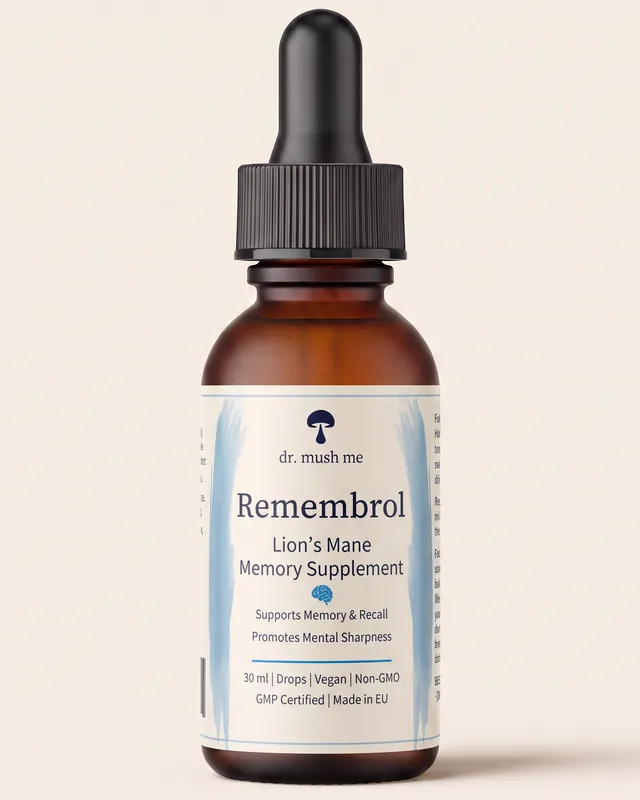
Lion's Mane and ashwagandha: can you take them together?
Published · Updated · 4 min read
In this article
Can you take Lion's Mane and ashwagandha together?
Yes. There’s no known interaction between Lion’s Mane and ashwagandha, and they’re often sold and taken together. They’re very different things, which is part of why people pair them:
- Lion’s Mane (Hericium erinaceus) is an edible mushroom. Supplements use the fruiting body or the mycelium.
- Ashwagandha (Withania somnifera) is a shrub from India. Supplements use the root.
What you need to check isn’t the pair. It’s your medicines, and that’s mostly about ashwagandha (see the safety section below).
How to take them together
Follow each label. For our drops that means:
| Lion’s Mane drops | Ashwagandha drops | |
|---|---|---|
| Daily amount on the label | 1 ml (about 30 drops), once a day | 1 to 2 ml a day |
| Most in a day | 2 ml | 2 ml |
| When most people take it | morning | evening |
| How | under the tongue for about 90 seconds, or in tea or coffee | under the tongue, or in a warm drink |
You can take them at the same time if that’s easier to remember. There’s no research saying spacing them out matters; morning and evening is simply how most people fit them into a day.
New to both? Start one, give it a couple of weeks, then add the other. If you get an upset stomach, you’ll know which one caused it.
Drinks with Lion's Mane and ashwagandha
Both come as drops, so they go into drinks easily. Three that work:
- Morning coffee or tea: stir 1 ml of Lion’s Mane drops into your usual cup. The taste disappears into coffee.
- Evening warm milk: warm a mug of milk or oat milk with a pinch of cinnamon, a little honey and a pinch of nutmeg, then stir in your ashwagandha drops off the heat. Ashwagandha is bitter, and the milk and honey cover it.
- Both in one: a cacao or hot chocolate takes both sets of drops well, if you’d rather have one drink a day.
Heat drives off some of the alcohol in the drops, which some people prefer.
Lion's Mane vs ashwagandha: what's the difference?
| Lion’s Mane | Ashwagandha | |
|---|---|---|
| What it is | an edible mushroom | a plant root |
| Traditional use | Chinese and Japanese traditional medicine, and cooking | Ayurveda (Indian traditional medicine) |
| Taste | mild, slightly seafood-like | bitter, earthy |
| Human research | a handful of small trials | dozens of trials, mostly on stress and sleep |
| Regulatory questions | none for the fruiting body | banned in Denmark; under review elsewhere in Europe |
What does the research say?
Ashwagandha has been studied in people far more. A 2022 review pooled 12 randomised trials with 1,002 adults and found lower stress and anxiety scores with ashwagandha than with placebo, though the reviewers rated the certainty of that evidence as low.
Lion’s Mane has three human trials that get cited most:
| Study | Who took part | How much a day | What form | How long |
|---|---|---|---|---|
| Mori and others, 2009 | 30 adults aged 50 to 80 in Japan | about 3 g | tablets of dried Lion’s Mane powder, three times a day | 16 weeks |
| Nagano and others, 2010 | 30 women in Japan | 2 g | dried fruiting body baked into cookies | 4 weeks |
| Docherty and others, 2023 | 41 adults aged 18 to 45 in the UK | 1.8 g | capsules of a Lion’s Mane product | 4 weeks |
They were small and tested Lion’s Mane, not any particular product. Nobody has studied the two taken together.
Safety: who should check first
- Pregnant or breastfeeding: avoid both.
- Thyroid medicine or a thyroid condition: ashwagandha may affect thyroid hormone levels. Ask your GP.
- Sedatives or sleeping tablets: ashwagandha may add to their effect.
- Blood pressure or diabetes medicines: ask your pharmacist before starting ashwagandha.
- Autoimmune conditions or immune-suppressing medicines: check with your GP first.
- Liver problems: rare cases of liver injury have been linked to ashwagandha; check first.
- Allergic to mushrooms: skip the Lion’s Mane.
The most common side effect of either is an upset stomach. Taking them with food usually helps.
Is ashwagandha legal in Ireland?
Yes, it’s on sale here as a food supplement. Denmark banned it in food supplements in 2023 and the Netherlands advised against it in 2024; as of mid-2026 there’s an EU-level discussion but no EU-wide ban.
Questions people ask
Which should I take first?
Whichever you’re more interested in. Add the second after a couple of weeks so you can tell them apart.
Can I add cordyceps too?
There’s no known interaction. See cordyceps vs ashwagandha.
How many Lion's Mane drops is 1 ml?
About 30 drops, or one and a half full droppers. Our Lion’s Mane drops dosage guide has a calculator.
25% off when you buy Lion’s Mane or ashwagandha drops. Use code LIONASH25 at checkout.
Remembrol Lion’s Mane drops · Ashwagandha drops
Sources
- Akhgarjand C, et al. Ashwagandha and anxiety and stress: systematic review and meta-analysis of randomised controlled trials. Phytother Res 2022. PubMed 36017529
- Mori K, et al. Improving effects of the mushroom Yamabushitake (Hericium erinaceus) on mild cognitive impairment. Phytother Res 2009. PubMed 18844328
- Nagano M, et al. Reduction of depression and anxiety by 4 weeks Hericium erinaceus intake. Biomed Res 2010. PubMed 20834180
- Docherty S, et al. The acute and chronic effects of Lion’s Mane mushroom supplementation on cognitive function, stress and mood in young adults. Nutrients 2023. PubMed 38004235
- NutraIngredients. Timeline: will authorities de-throne the king of herbs? (July 2026). nutraingredients.com
- Remembrol Lion’s Mane drops and ashwagandha drops labels and supplier specifications.
This article is general information, not medical advice. If you take any medication, talk to your GP or pharmacist before taking any supplement.
This article is general information, not medical advice. If you have a health condition or take medication, talk to your GP or pharmacist first. Food supplements should not be used as a substitute for a varied, balanced diet and a healthy lifestyle. Do not exceed the recommended daily dose. Not suitable for children, or during pregnancy or breastfeeding. Keep out of reach of children.