What is Lion’s Mane mushroom? A plain guide for Ireland
Lion’s Mane (Hericium erinaceus) is an edible white mushroom that grows on old beech and oak trees. It is not the jellyfish. And it has nothing to do with magic mushrooms: no psychedelic effect, not even slightly.
Over the past couple of years it has had a lot of attention in Ireland, from podcasts, the radio and the Holland & Barrett shelf. Some of that attention rests on something real. Some of it doesn’t. This guide covers both.
I make Lion’s Mane drops in Waterford. I’m telling you that up front because it matters for everything that follows. I sell this product, so read what I write with that in mind. Then look at the research section and judge for yourself.
What it is, where it grows, how it’s eaten
It goes by a few names: bearded tooth, hedgehog fungus, pom pom.
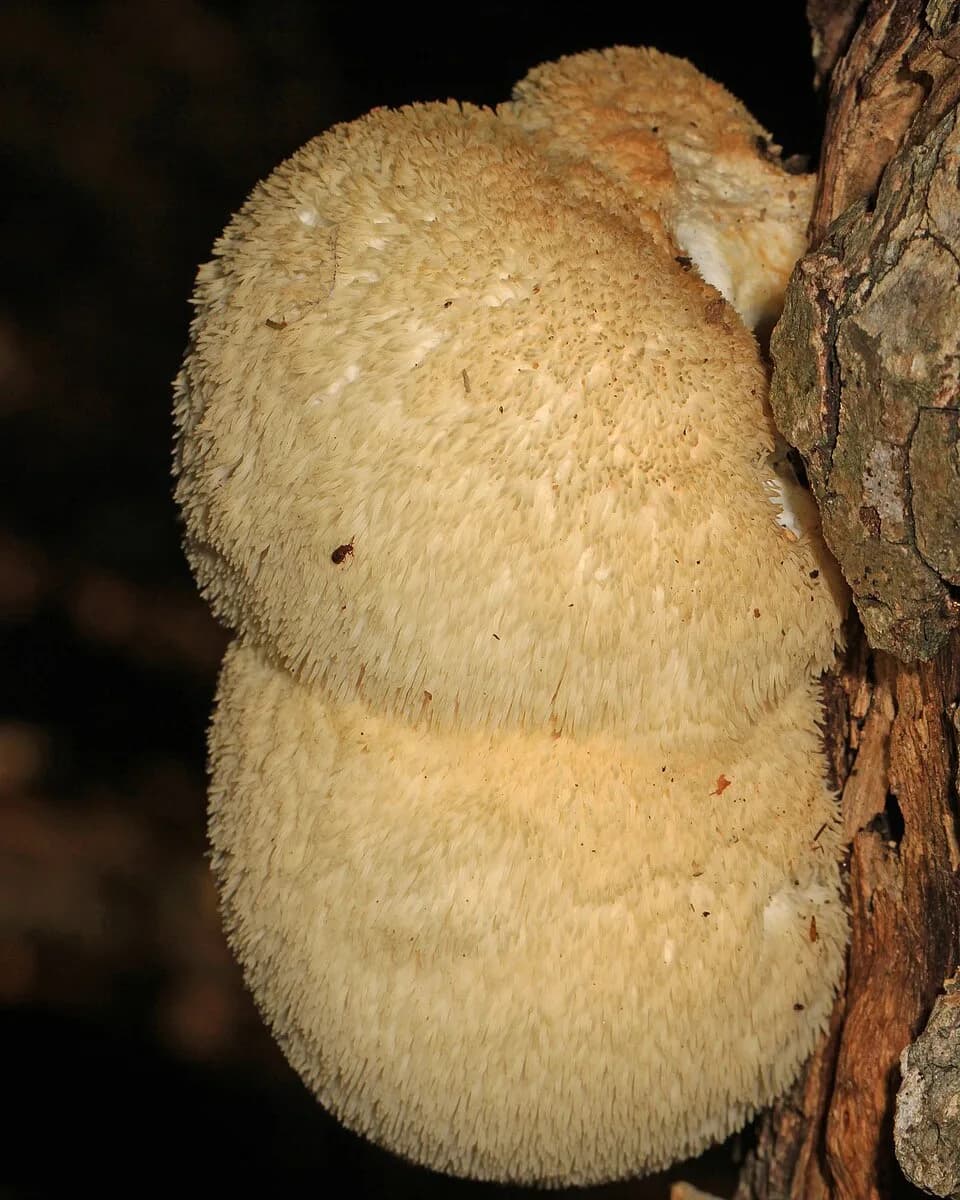
It grows on old or dying hardwood, mostly beech and oak, from roughly August to November in Europe. It is hard to mistake: a white, tumbling mass of soft spines, somewhere between a cauliflower and something you might find washed up on Tramore Strand.
It is rarely recorded in Ireland or Britain. In Great Britain it is legally protected, and picking it in the wild there is illegal. Only about a hundred host trees were recorded in Britain between 1960 and 2007, close to half of them in the New Forest. If you come across one on a walk, leave it.
Young and fresh, it is a choice edible. The texture is like fish or tender meat, and the taste is often compared to crab or lobster. It has been used in Chinese tradition for centuries and was first grown commercially in China in 1988. The Lion’s Mane in supplements is cultivated, usually in China, Poland or elsewhere in Europe.
A mushroom with a long history
Long before anyone put it in a bottle, Lion’s Mane had a reputation.
In Japan it is called yamabushitake. The name comes from the yamabushi, the mountain hermits of Japan’s old Shugendō tradition, who lived and trained in the forests where it grows. The usual explanation is that the shaggy white mushroom looks like the tufted pompoms that hang from their robes. Japanese legend goes further: the story is told that the monks gathered it and ate it before long days of meditation. It’s a lovely story. I can’t find anything written down from the time to prove it, so take it as legend, not history.
In China it is hóutóugū, the “monkey-head mushroom”, because a fresh one looks a bit like the back of a small monkey’s head. It was prized in the kitchen, not the medicine cabinet first. There’s an old saying that pairs it with the most expensive food of the sea: shān zhēn hóutóu, hǎi wèi yànwō, “from the mountains, monkey head; from the sea, bird’s nest”. It is still counted among China’s “eight great mountain delicacies”, and it turns up at Chinese New Year banquets today.
In the kitchen cooks have long used it as a stand-in for seafood. Sliced and fried in butter, it goes golden at the edges and pulls apart in flakes, which is why people compare it to crab or lobster. Some vegetarian restaurants serve it as “crab cakes”.
Closer to home it is a rare sight. In Britain it is a protected species, and picking it in the wild there is against the law. Most British records come from a handful of ancient beech trees, close to half of them in the New Forest. Sightings in Ireland are rare enough to be worth reporting. The Lion’s Mane in my drops is grown on purpose, as whole mushrooms, in Poland, so nobody has to go hunting the wild ones.
Fruiting body or mycelium, and why it matters on the label
This is the section most brands would rather you skimmed.
The fruiting body is the mushroom itself, the shaggy white part. The mycelium is the root-like network it grows from. They are not the same thing, and the EU treats them differently.
The fruiting body and its water extracts have a history of being eaten as food, so they are not “novel foods”. Dried mycelium powder is a novel food under EU law, which means it needs approval before it can be sold as a food here.
There is a practical difference too. Mycelium is usually grown on grain such as oats or rice, and the grain stays in the powder. One lab analysis of a mycelium blend found about 66 g of starch per 100 g and only about 3 g of beta-glucan. Fruiting bodies had under 1 g of starch per 100 g. Watch for label words like “myceliated grain”, “mycelial biomass” or “full-spectrum mycelium”.
In plain terms: a capsule that doesn’t say “fruiting body” may contain more grain starch than mushroom. In 2022 the US testing company ConsumerLab failed four lion’s mane products because they were mycelium sold as “mushroom”.
What “extract” and “20,000 mg” on a label mean
When a label says “Lion’s Mane 20,000 mg”, that number is nearly always the input: the weight of fresh or dried mushroom that went into making the extract. It is not what is in your dose. A 10:1 extract takes about 10 kg of dried mushroom to make 1 kg of extract. So 2,000 mg of extract can be sold as “20,000 mg equivalent”.
I need to be straight about my own bottle here. Dr. Mush Me drops use the equivalent of 20,000 mg of dried fruiting body per 30 ml. That is the input figure, and it works exactly the way I’ve just described. I’m not going to criticise the number and then quietly use it myself. One dose is 1 ml a day (about 30 drops), so each dose comes from roughly 667 mg of dried fruiting body. A bottle is a month’s supply.
“Polysaccharides” on a label says less than it seems to, because starch is a polysaccharide too. The figure worth asking for is beta-glucan, measured by the Megazyme method. Megazyme, as it happens, is an Irish company.
What the research in people does and doesn’t show
| Study | People | What they took | How long | What was found | Limits |
|---|---|---|---|---|---|
| Mori 2009, Japan | 29 analysed, aged 50–80, mild cognitive impairment | ~3 g/day dried fruiting body | 16 weeks + 4 off | Higher than placebo on a memory scale at weeks 8–16; scores fell back after stopping | Tiny; in-house scale; linked to a grower |
| Saitsu 2019, Japan | 31, average age ~61 | Fruiting body | 12 weeks | One test of three improved | Tiny |
| Li 2020, Taiwan | 41 completed, mild Alzheimer’s, ~75 | Mycelium product (novel food in the EU) | 49 weeks | Mostly no difference from placebo | Pilot; maker staff; mycelium |
| Grozier 2022 | 24 students | 10 g/day in muffins | 4 weeks | No effect | Small |
| La Monica 2023, USA | 40, aged 18–50 | 1 g fruiting body, single dose | 1 day | Some reaction-time items better; focus not | One dose; part-funded by a supplier |
| Docherty 2023, UK | ~41, aged 18–45 | 1.8 g/day | 28 days | One speed test faster; two recall results worse | Pilot; donated product |
| Surendran 2025, UK | 18, ~23 | 3 g extract, single dose | 1 day | No overall change; some tests better, some worse | Brand-linked authors |
| Daoust 2026 (preprint) | 109, aged 40–75 with self-reported memory difficulty | Fruiting body + mycelium, 2 g/day | 8 weeks | “Modest” change on one attention task; self-rated sleep and mood | Supplier’s staff are authors; not peer reviewed |
The studies, one by one
Here’s what each study actually did and found, in plain words. I’ve put the encouraging results in, and the disappointing ones, because you deserve both.
Mori 2009, Japan. The one everyone quotes. 30 Japanese men and women aged 50 to 80, all with mild memory complaints diagnosed by a doctor. Half took tablets of dried Lion’s Mane fruiting body (about 3 g a day), half took a dummy tablet, for 16 weeks. The Lion’s Mane group scored higher on a memory and thinking test from week 8 onwards, and the gap grew the longer they took it. Then the interesting part: four weeks after they stopped, their scores dropped back. That’s either a sign something real was happening, or a sign it doesn’t last. Only 29 people finished, and the company that grew the mushroom was involved.
Saitsu 2019, Japan. 31 people, average age about 61, took fruiting body powder or a dummy for 12 weeks. On one of the three thinking tests, the Lion’s Mane group did better. On the other two, no difference. Small study, mixed result.
Li 2020, Taiwan. 41 people in their mid-70s with early Alzheimer’s took a mycelium product (not a fruiting body, and not legal to sell as food in the EU) for 49 weeks. Compared with placebo, most scores showed no difference. One measure of everyday living and one eye test came out better. Run by staff of the company that made it.
Grozier 2022. 24 university students ate muffins with 10 g of Lion’s Mane a day for four weeks. No effect on anything measured.
La Monica 2023, USA. 40 adults aged 18 to 50 took one 1 g dose of fruiting body. An hour later, some reaction-time tasks were faster. Focus and other tests didn’t change. One dose, partly funded by a supplier.
Docherty 2023, UK. About 41 young adults took 1.8 g a day for 28 days. One speed test got faster. Two memory-recall results got worse than placebo. The authors called it a pilot.
Surendran 2025, UK. 18 young adults, one 3 g dose. No overall change. Some tests up, some down.
Daoust 2026 (preprint). The biggest so far: 109 people aged 40 to 75 who said their memory wasn’t what it was. Half took 2 g a day of a fruiting body and mycelium blend for 8 weeks, half a placebo. The Lion’s Mane group did modestly better on one attention task, and rated their own sleep and mood a bit better. No side effects reported. The supplier’s staff were among the authors, and it hasn’t been through peer review yet.
Where that leaves us. The most encouraging results come from older people in Japan taking the whole fruiting body every day for months, which is the closest match to what I make. The results in young people and from single doses are mostly flat. Every study is small. If you’re curious, the honest way to find out is to try it for a few weeks and judge for yourself, which is what the 60-day guarantee is for.
A few things worth noticing. Most studies had fewer than 50 people. Most were linked to a company selling the product. In one, two memory measures came out worse with Lion’s Mane than with the placebo. No proper meta-analysis (a combined look at all the trials) exists. Memorial Sloan Kettering Cancer Center describes the human data as “limited”. There is no authorised EU health claim for Lion’s Mane.
Nobody can honestly promise you a result from Lion’s Mane. I’m not going to try.
Safety, and who should check first
The US National Institutes of Health (LiverTox) rates Lion’s Mane as an unlikely cause of liver injury. In trials, stomach upset was the most common complaint, usually in fewer than one in ten people, and there was the odd skin rash. Allergic reactions are possible. There is no safety data for pregnancy or breastfeeding.
Check with your GP or pharmacist before starting if you:
- take blood thinners (warfarin, a DOAC, or regular aspirin). Test-tube research only, not confirmed in people, but worth a short conversation
- take diabetes medicine. Animal research only, but worth mentioning
- have a mushroom or mould allergy
- have kidney or liver problems, or are being treated for cancer or an immune condition
- have a diagnosis of dementia or any memory condition. Lion’s Mane is not a treatment for any of these, and your care team should know what you’re considering
If you notice stomach upset, a rash or anything unusual, stop and ask your pharmacist.
Forms compared, with price per day
| Form | Example | About per day | Worth knowing |
|---|---|---|---|
| Drops | Dr. Mush Me, €32.95 a bottle (Buy 2 Get the 3rd Free) | about €1.10 (about 73c on Buy 2 Get the 3rd Free) | Fruiting body, grown in Poland. Dual extract (water and alcohol), ultrasonic-assisted. Lab report published. Under the tongue or in tea |
| Capsules | Irish Botanica, €23.99 for 60 | €1.60–2.40 | Label doesn’t say fruiting body or mycelium |
| Extract capsules | Osavi 30:1, €22.95 for 120 | ~€0.19 | Ask for the extraction method and a beta-glucan figure |
| Powder | Irish Botanica, €41.99 per 100 g | ~€1.26 | No fruiting body or mycelium disclosure |
| Gummies | Novomins, €21.99 for 30 days | ~€0.73 | Often blended; usually added sugar |
| Fresh | Specialist growers and markets | Varies | Good eating; not a measured supplement dose |
Cheap isn’t a bargain if it’s mostly starch. Dear isn’t quality if there’s no lab report to look at. If you want to see what we sell and what it costs, that is Lion’s Mane in Ireland.
How people take it
There’s no one right way. These are the ones I hear about most.
- In the morning cuppa. A dropper (1 ml, about 30 drops) stirred into tea or coffee. This is how most of my customers do it, because it ties it to something they do every day anyway.
- Under the tongue. Hold it there for about 90 seconds, then swallow. Quick, and you notice the taste: mild and gently earthy, a bit like a light mushroom broth.
- In food. Powders go into porridge, soup or a smoothie. Fresh Lion’s Mane, if you can get it, is lovely sliced thick and fried in butter with a bit of garlic.
- As capsules or gummies. The easiest if you already take tablets, though gummies usually carry sugar and less mushroom.
How long before you’d know? The studies that found anything ran for 8 to 16 weeks, and in the Japanese study the difference showed from week 8. So a fair trial is weeks, not days. That’s why I ask people to give it at least three weeks, and why the guarantee runs for 60 days.
Morning or evening? The studies used morning or with-meal doses. Most people pick a time they won’t forget.
How to choose one: 8 questions to ask any brand
These work on every Lion’s Mane brand in Ireland, including mine. I have already put them to the ones on the shelf here: Lion’s Mane brands in Ireland compared.
- Fruiting body or mycelium? It should say so on the label. If the brand doesn’t know, move on.
- Was it grown on grain? Grain stays in the powder as starch.
- Is a lab report published, with beta-glucans measured by the Megazyme method? A polysaccharide figure on its own tells you very little.
- Single ingredient or a blend? Blends with ginkgo, ashwagandha or B vitamins make it impossible to know the dose of anything.
- Where was it grown? A good brand will tell you.
- What does the big mg number mean, and what’s in one dose?
- What does it cost per day? Divide the price by the number of days it lasts, not by the size of the headline number.
- Is there a real person you can ring, and a money-back guarantee?
If you are about to order from someone, there is a longer version of this: buying Lion’s Mane in Ireland: what to check.
Get the printable Lion’s Mane Buyer’s Checklist
One page you can bring to the shelf, and a second page of questions to bring to your GP or pharmacist. Plus a short email from me each week.
Things you might have heard
| You may have heard | What’s actually true |
|---|---|
| “Proven to prevent dementia” | No study has shown this, and there is no authorised health claim. In 2023 the UK advertising regulator ruled against a mushroom brand (Dirtea) for claims about nerve regeneration and “supports dementia and Alzheimer’s”. |
| “Regrows brain cells” | Seen in cells and animals only |
| “Mycelium is the same as the mushroom” | The EU says no. Dried mycelium powder is a novel food |
| “High polysaccharides means quality” | Starch counts as a polysaccharide. Ask for beta-glucan |
| “20,000 mg per capsule” | That’s the input equivalent, not what’s in the dose |
| “Natural means no side effects” | Stomach upset, rash and allergy have been reported |
| “Pick your own” | Rare here, and illegal to pick in Great Britain |
| “Lion’s Mane stings” | That’s the jellyfish |
Questions people ask
- What does it taste like?
- The drops taste mild and gently earthy, a bit like a light mushroom broth, with a small warm note from the extract. In tea or coffee you’ll hardly know it’s there.
- Is it a magic mushroom?
- No. Lion’s Mane contains nothing psychedelic. It’s a food mushroom, sold in markets and restaurants.
- Is it the same as the lion’s mane jellyfish?
- No relation, apart from the name. The jellyfish is the one that stings swimmers off Irish beaches.
- Can I take it with my tablets?
- Most people can, but check with your GP or pharmacist first if you take blood thinners or diabetes medicine, or have a mushroom or mould allergy. Bring the bottle with you so they can see what’s in it.
- How long should I try it for?
- At least three weeks. The studies that found a difference ran for two to four months.
- Is fresh better than an extract?
- Fresh Lion’s Mane is a great food if you can find it, but it’s hard to get in Ireland and doesn’t keep. An extract made from whole fruiting bodies is the practical way to have it every day.
- Why is yours made from fruiting bodies?
- Because that’s the mushroom itself, it’s what the Japanese studies used, and it doesn’t come with grain starch in it. My lab report is published, so you can check.
- What if it’s not for me?
- Email refunds@drmushme.ie within 60 days. We send you a prepaid return label and refund every cent, even if the bottle is opened.
Who wrote this
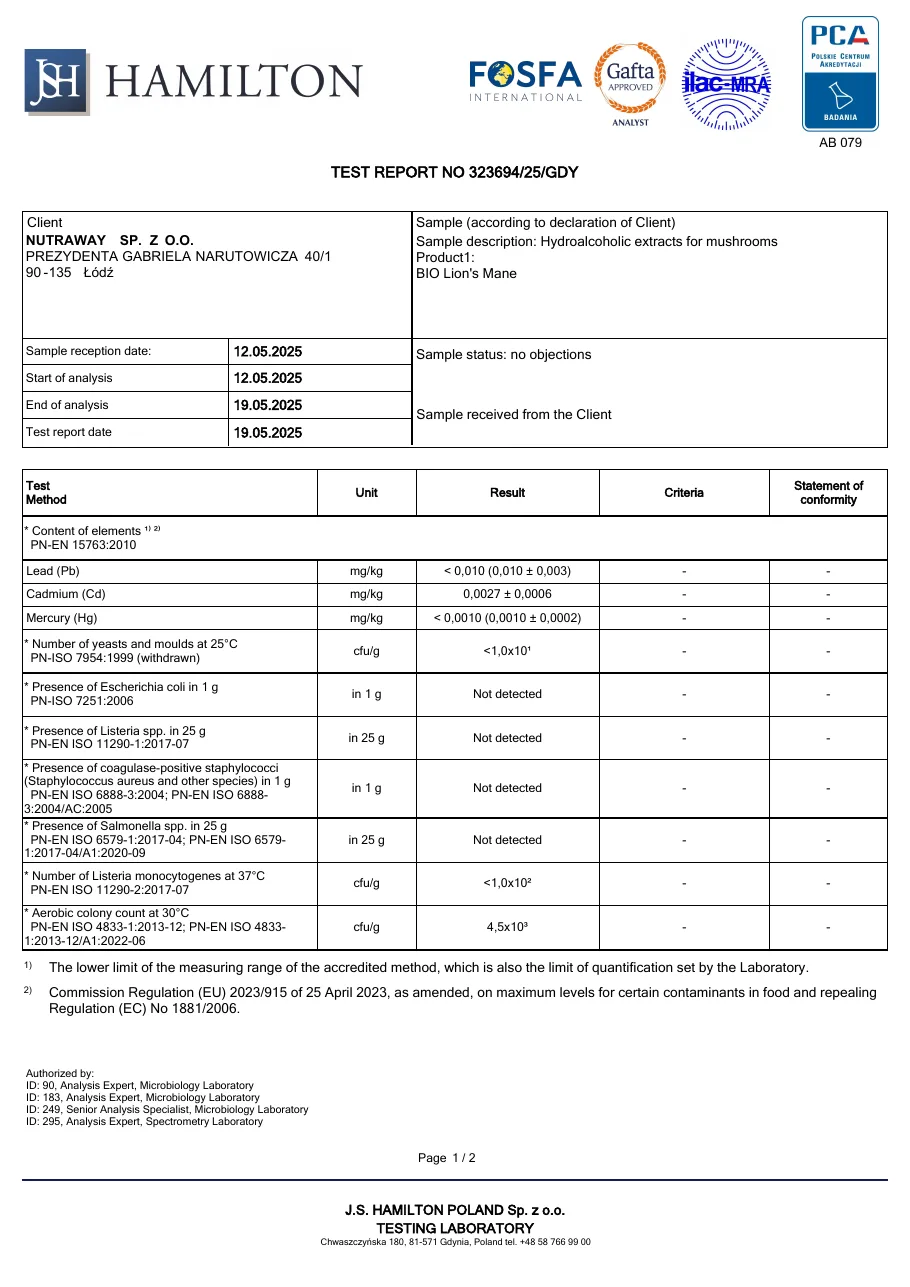
I’m Brian Cusack, and I run Dr. Mush Me from Waterford. I make Lion’s Mane drops from fruiting bodies grown in Poland, and I publish the lab report. My current lab report (J.S. Hamilton, Poland, May 2025) checks for heavy metals (lead, cadmium, mercury) and for microbes such as E. coli, Listeria and Salmonella. It does not yet give a beta-glucan figure, and I’d rather tell you that than leave you to find out.
I sell Lion’s Mane, so you’re right to read this with some scepticism. “He sells it, so he would say that, wouldn’t he.” Fair enough. What I can offer is the lab report, a 60-day money-back guarantee and a phone number. If something on this page looks wrong, or a study has been updated, email me and I’ll look at it.
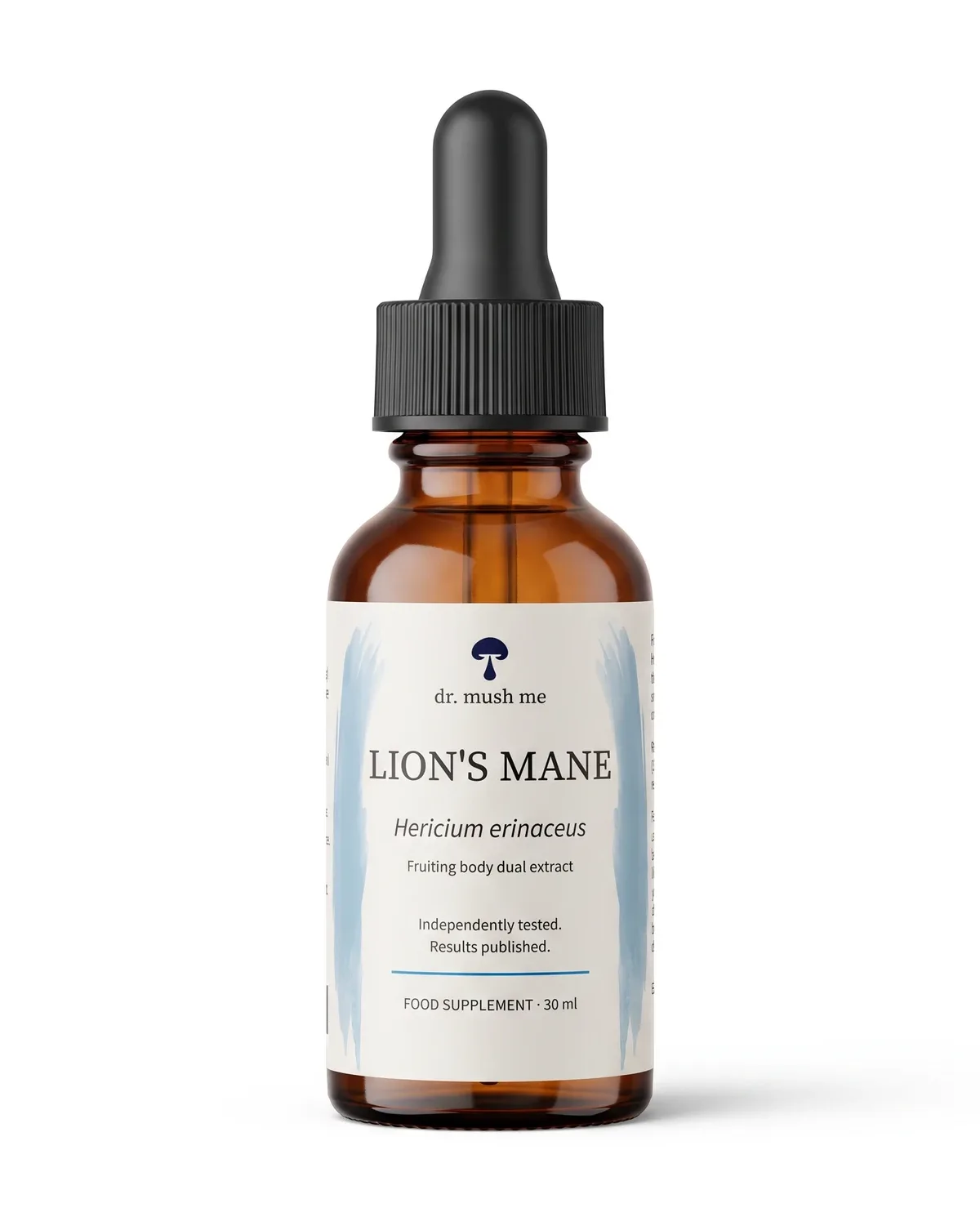
We make it five ways: these 30 ml drops, a 60 ml bottle, capsules, powder and gummies. They are all on the full Lion’s Mane range, with the price of each.
Get the printable Lion’s Mane Buyer’s Checklist
Eight questions. One page. Works on any brand. Plus a short email from me each week.
Sources
- Hericium erinaceus overview
- MSKCC, Lion’s Mane
- First Nature
- Wild Food UK
- IUCN Red List
- Natural England, Schedule 8
- Kew/COL Fungi
- European Commission, AESAN novel food consultation (mycelium)
- European Commission, Finland 2025 consultation (water extract)
- McCleary & Draga, J AOAC Int 2016 (beta-glucan in mushrooms), Megazyme authors
- ConsumerLab 2022
- Mori 2009
- Saitsu 2019
- Li 2020
- Grozier 2022
- Docherty 2023
- Surendran 2025
- La Monica 2023
- Daoust 2026 preprint (not peer reviewed)
- NIH LiverTox
- FSAI food supplements
- ASA ruling, Dirtea 2023
- Examine.com, “Where do the many names of Lion’s Mane come from?”
- Science and Technology Daily (China), 26 Aug 2024 (山珍猴头,海味燕窝; the eight great mountain delicacies)
Nothing on this page is medical advice. Your GP knows you; this page doesn’t.
Food supplement. Food supplements should not replace a varied, balanced diet and a healthy lifestyle. Do not exceed the recommended daily dose. Keep out of reach of young children.