Does cordyceps increase dopamine? What the research shows
Published · Updated · 3 min read
In this article
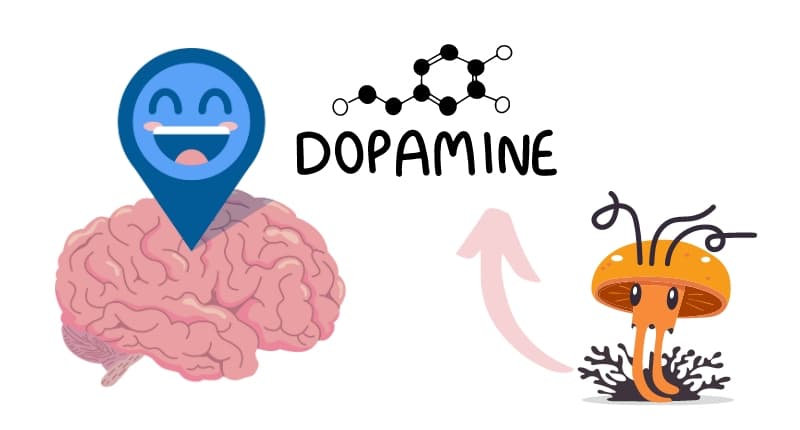
Does cordyceps increase dopamine?
In people, we don’t know: no human study has measured it. That’s the honest answer, and most pages that say “yes” are quoting animal research without saying so.
What did the animal studies find?
Two studies come up most:
| Study | What was given | To whom | What happened |
|---|---|---|---|
| Cheng and Zhu, 2019 | cordycepin (a single compound from cordyceps) | rats given a chemical (MPTP) that kills dopamine-producing cells, plus cells in a dish | fewer dopamine-producing cells were lost, movement was better, and markers of inflammation were lower |
| Wang and others, 2017 | extract of Paecilomyces hepiali (the fungus sold as “CS-4” cordyceps), 0.08 to 2 g per kg a day for 4 weeks | rats put under weeks of unpredictable stress | dopamine and serotonin measures in blood and brain moved back towards normal, and the rats behaved less like stressed animals |
A 2024 study in mice found similar protective effects of cordycepin in the same Parkinson’s model.
Why those results don't tell you much about a supplement
- Animals, not people. Rodent brains and metabolism are different, and most findings in rodents never carry over.
- The doses are huge. Using the standard method for converting an animal dose to a human one, the top dose in the rat study is roughly 20 g of extract a day for a 70 kg adult. A cordyceps tincture gives you a few hundred milligrams’ worth of mushroom a day.
- A purified compound isn’t the mushroom. The Parkinson’s studies used pure cordycepin. How much cordycepin is in a given supplement varies, and most labels don’t say.
- Protecting cells isn’t the same as raising dopamine. In the Parkinson’s studies, cordycepin limited damage to dopamine cells. It didn’t push dopamine above normal.
How could cordyceps affect dopamine at all?
Cordycepin is chemically similar to adenosine, a messenger in the brain that works alongside dopamine. Caffeine is the familiar example of this system: it blocks adenosine receptors, which is part of why it feels stimulating. Whether cordycepin from a supplement reaches the brain in amounts that matter in people hasn’t been studied.
Questions people ask
Is cordyceps like caffeine?
They both touch the adenosine system, but in different ways, and cordyceps hasn’t been shown to have caffeine-like effects in people. Many people take cordyceps in their morning coffee anyway.
Can I take cordyceps with ADHD medication, antidepressants or Parkinson's medication?
Ask your GP or pharmacist first. These medicines act on dopamine and serotonin, and nobody has studied how cordyceps combines with them.
Will cordyceps improve motivation or focus?
There’s no human research showing that.
Does it show up on a drug test?
No. See does cordyceps show up on a drug test.
See what’s in our cordyceps drops.
Sources
- Cheng C, Zhu X. Cordycepin mitigates MPTP-induced Parkinson’s disease through inhibiting TLR/NF-κB signaling pathway. Life Sci 2019. PubMed 30790609
- Wang J, et al. Dopamine and serotonin contribute to Paecilomyces hepiali against chronic unpredictable mild stress induced depressive behavior in Sprague Dawley rats. Mol Med Rep 2017. PubMed 28849191
- Neuroprotective effects of cordycepin on MPTP-induced Parkinson’s disease mice. Free Radic Biol Med 2024. PubMed 38479634
- Animal-to-human dose conversion by body surface area (FDA method): rat dose × 6/37.
This article is general information, not medical advice. If you take any medication, talk to your GP or pharmacist before taking any supplement.
This article is general information, not medical advice. If you have a health condition or take medication, talk to your GP or pharmacist first. Food supplements should not be used as a substitute for a varied, balanced diet and a healthy lifestyle. Do not exceed the recommended daily dose. Not suitable for children, or during pregnancy or breastfeeding. Keep out of reach of children.